Beyond the Bag
How often have you passed the baking aisle to grab a bag of flour? Do you have a particular brand you like or do you look for the most cost effective? Consumerism is at an all time high in the United States with what feels like endless options and tons of variety. We all want food that's wholesome, delicious, and affordable. Yet standing in the baking aisle, it can feel as though we're asked to choose between quality and cost.
Understanding the fundamentals of flour is important when baking. Do we go with all purpose, whole grain, whole wheat? What about those speciality flours we know even less about? Growing up, there was always a familiar bag of Gold Medal Flour tucked inside the pantry. It was the flour behind Saturday morning pancakes, warm coffee cake, and nearly every holiday cookie that came from our kitchen. Over the years, I tried different flours. I found trying to make gluten free blend was the most complicated and I was always disappointed with the outcome. Whole wheat was great- but why was it so crumbly? So I went back to bleached all-purpose flour, without the bat of an eye.
Like many people on a journey toward better health, I started reading food labels. I wanted to know what was really in the foods I was buying. How much of what we eat is made from whole, natural ingredients, and how much has been altered through processing? Then one day, while reaching for a bag of flour, I paused.
It should just be flour...right?
Instead, I noticed that many commercial brands listed enriched flour as the primary ingredient. That simple discovery led to even more questions.
What does "enriched" actually mean? Why are vitamins and minerals added back into flour? What happened to the nutrients in the first place? And is enriched flour really the same as flour in its natural state? That moment sparked a journey of research into one of the most common ingredients found in our kitchens. I wanted to understand how flour is made, what happens during processing, how different types of flour compare nutritionally, and how those differences affect both the food we bake and the nutrition our bodies receive.
Before we dive into the details, let's start with the three types of flour you're most likely to encounter today: whole grain flour, enriched (refined) flour, and flour milled from wheat berries. While they may all be used for baking, they differ significantly in how they're processed, their nutritional value, and the ingredients they contain.
A Journey Beyond the Bag
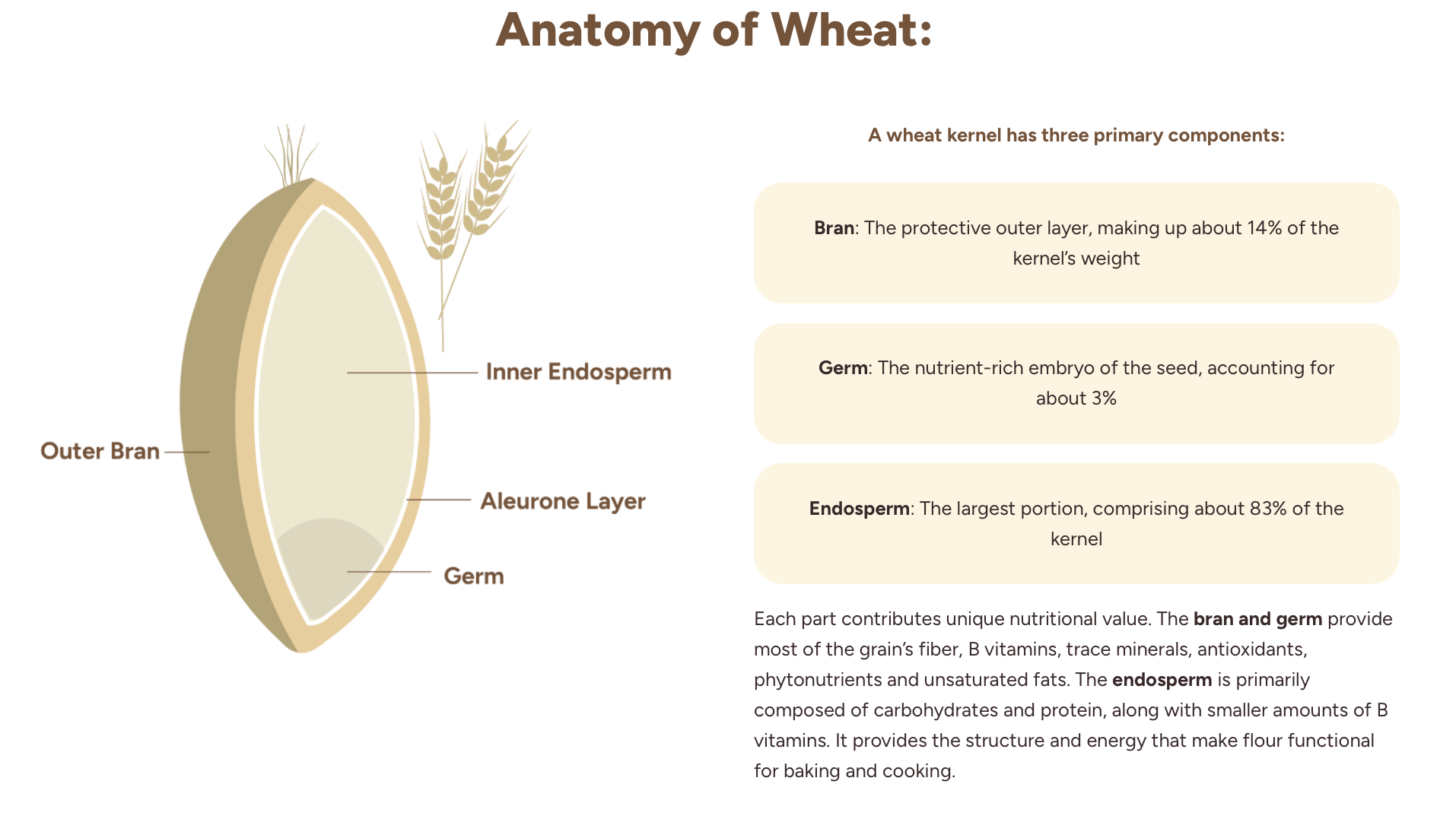
Whole grain flour is simply the entire wheat berry, ground into flour. Nothing is stripped away. The fiber-rich bran, the nutrient-filled germ, and the starchy endosperm all remain together, just as nature intended. That means it naturally carries the fiber, healthy fats, vitamins, minerals, and plant compounds that were present in the original wheat berry. Research has associated whole grains to help you benefit from soluble fiber, improved gut health, and has been linked to improve overall health. It can be stored in an airtight container for up to 3 months. And that brings us to the next stop on our journey: enriched flour. If whole grain flour keeps everything the wheat berry has to offer, why do so many bags on grocery store shelves list enriched flour instead?
Enriched (refined) flour begins the same way as whole grain flour—with a wheat berry. The difference is what happens next. During milling, the bran and germ are removed, leaving only the endosperm. This creates the soft, white flour many of us know and love for cakes, cookies, pastries, and tender breads. It also gives flour a much longer shelf life from 6 to 12 months. What makes it “enriched?” After the milling process, nutrients are added back into the flour.
A quick history- Between the dust bowl and the Great Depression, the U.S. experienced a mass famine for the fire time. During WWII, it was noted that deficiencies among Americans were increasing. Enriched flour was introduced into the market during this time by the FDA to help with vitamin deficiencies.
Enriched flour contains added Iron, B Vitamins, and (later years) Folic Acid. Refined flour contains less fiber which breaks the carbohydrates down more quickly. It’s not as beneficial to our gut health, often leads to glucose spikes, and is considered an empty carb which makes us hungrier sooner. Next, we'll look at flour made from freshly milled wheat berries and why many home bakers are rediscovering this traditional way of baking.
Freshly milled flour from wheat berries is made by grinding whole wheat berries—the unprocessed kernels of wheat—into flour. It contains three simple parts: the bran, the germ, and the endosperm. Together, they hold everything needed to grow a new wheat plant—and everything needed to create a truly whole grain flour. When wheat berries are milled at home or by a local mill, the entire kernel is ground into flour just moments before baking. Nothing is removed. Nothing is added. It is flour in its freshest, most natural form.
Unlike refined flour, freshly milled flour isn't designed for long-term pantry storage. For the best flavor and quality, it's ideal to use it within a 3 days of milling. It’s noted that fresh milled wheat berries lose up to 50% of its nutritional value within1 day, and almost 90% of its nutritional value within 3 days. One of the greatest gifts of freshly milled flour is its fiber. That fiber doesn't simply help move food through our digestive system—it also feeds the beneficial bacteria living in our intestines. As these microbes ferment certain fibers, they produce compounds that help support the health of the intestinal lining and contribute to a thriving gut microbiome.
Coming Full Circle
As I learned more about wheat berries, I realized they weren't introducing me to something new. Instead, they were reconnecting me with something very old. For thousands of years, families milled grain shortly before baking. Fresh flour wasn't a specialty product—it was simply how bread was made.
Today, whether you choose commercially milled whole grain flour or decide to grind your own wheat berries at home, you're beginning with the same whole grain. The difference is simply time. One has been waiting on a shelf, while the other has just come from the mill. Sometimes, the freshest ingredients remind us that the simplest ways are often the ones closest to nature.
